

From Coupe to Tulip: Why Champagne Glasses Changed

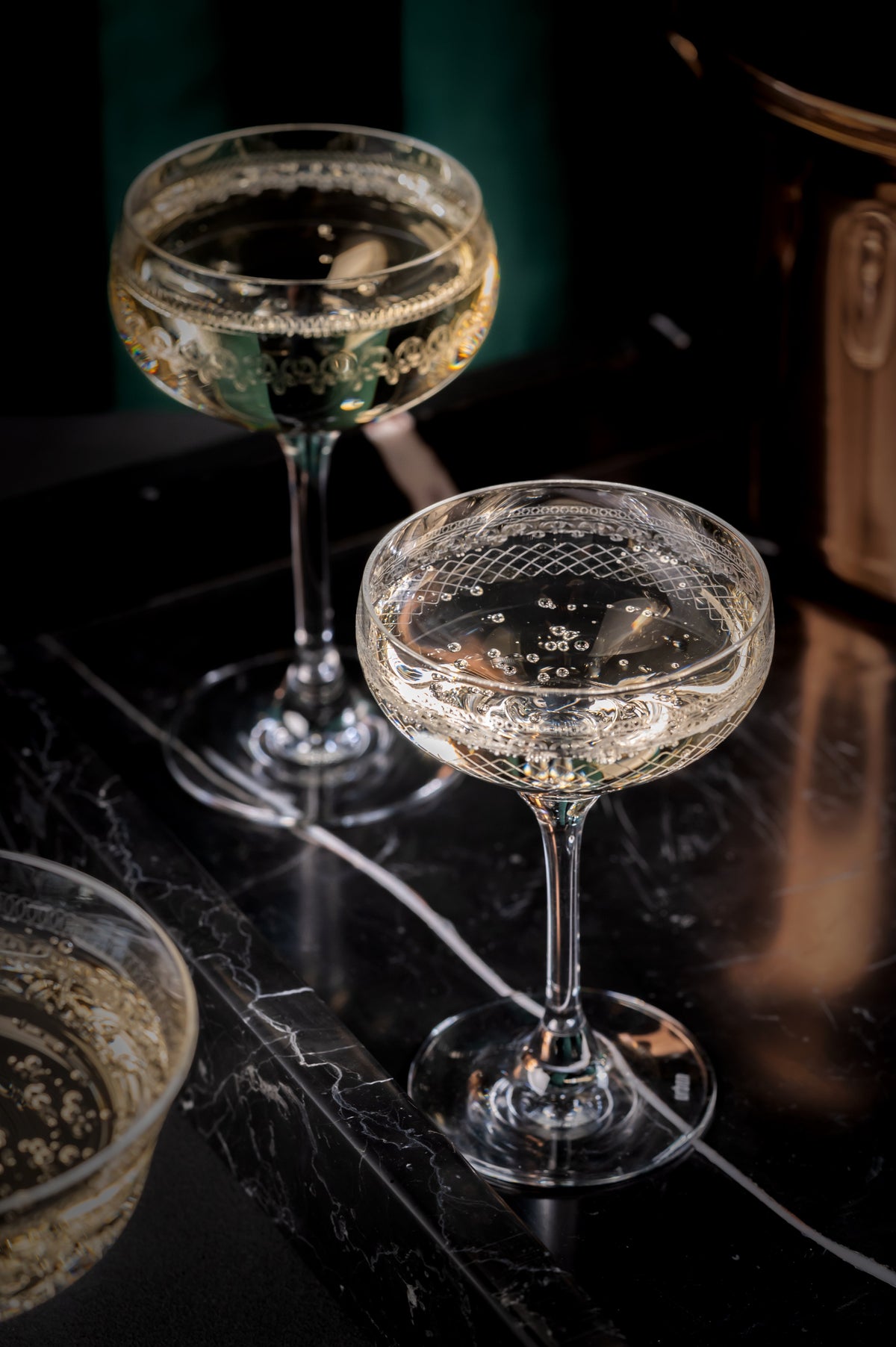
The Champagne coupe is one of the most recognisable glasses ever made. Its wide, shallow bowl immediately brings to mind Champagne towers, grand parties and the glamour of another era. For decades, however, it has been largely replaced by the flute, and today even the classic flute is giving way to a new generation of wider, tulip-shaped glasses.
The change is not simply about fashion. The shape of a glass affects how Champagne behaves once it is poured, from the way it holds its bubbles to how its aromas develop. The evolution from coupe to flute and then to tulip reflects a growing understanding of what happens inside the glass.
The Champagne coupe came first

The coupe became closely associated with Champagne during the 19th and early 20th centuries, when its elegant silhouette suited the style of formal entertaining. Later, it became a fixture of Art Deco imagery and remains closely connected with Champagne towers and celebratory occasions.
It also gave rise to one of the most persistent stories in glassware history. According to legend, the coupe was modelled after the breast of Marie Antoinette; other versions name Madame de Pompadour. It is a memorable story, but there is no reliable historical evidence to support it, and shallow drinking vessels existed long before these legends became popular.
What ultimately changed the coupe’s place at the table had less to do with history and more to do with the behaviour of Champagne itself.
Why the coupe fell out of favour
Champagne contains dissolved carbon dioxide, which gradually escapes after the bottle is opened. Once the wine is poured, the shape of the glass influences how quickly that gas is released.
Because a coupe has such a broad surface area, more of the wine is exposed to the air. This allows carbon dioxide to escape relatively quickly, so the Champagne can lose its effervescence sooner than it would in a narrower glass. The open shape also means the wine can warm more rapidly.
None of this makes the coupe obsolete. It remains a beautiful glass for cocktails, celebrations and Champagne towers, but it is not necessarily the most practical shape when keeping Champagne lively is the priority.
Why the flute became the standard
The flute solved the coupe’s main weakness by taking the opposite approach. Its tall, narrow bowl exposes much less wine to the air, helping to slow the loss of carbon dioxide and preserve the bubbles for longer.
The shape also puts the bubbles on display. As they rise through the long bowl, they become part of the visual experience of drinking Champagne, which helped make the flute almost synonymous with sparkling wine throughout the 20th century.
For many years, that seemed to settle the question. If Champagne was defined by its bubbles, a narrow glass appeared to be the obvious choice. But over time, another consideration became increasingly important: aroma.
Why the classic flute is changing too
Champagne is still wine, and aroma plays a large part in how we perceive flavour. An extremely narrow flute leaves relatively little space for the wine to open and for aromas to gather inside the bowl before reaching the nose.
This matters particularly with more complex Champagnes, where the character of the wine goes well beyond carbonation. A glass that preserves bubbles perfectly but restricts aroma can limit part of what the wine has to offer.
That led glassmakers towards a shape that sits between the coupe and the traditional flute.
The rise of the tulip-shaped Champagne glass

Modern Champagne glasses are often wider through the middle and gently tapered towards the rim. The broader bowl gives the wine more room to release its aromas, while the narrower opening helps concentrate them as you drink.
At the same time, the surface of the wine remains smaller than it would be in a coupe, helping to preserve its effervescence. The result is a glass that balances the qualities that made both earlier shapes successful: the openness of the coupe and the bubble retention of the flute.
This is why the tulip has become such an important shape in contemporary Champagne glassware. It reflects a shift away from thinking about Champagne only in terms of bubbles and towards treating it as a wine with aroma, texture and complexity.
Coupe, flute or tulip?
There is no need to choose one shape for every occasion. A coupe remains an excellent choice when presentation matters, particularly for Champagne towers, cocktails and more theatrical serving. A flute is useful when maintaining carbonation and emphasising the visual movement of the bubbles are the main priorities.
For Champagne itself, especially more complex styles, a tulip-shaped glass offers more room for aroma while still helping the wine retain its sparkle. It is a more balanced approach, and one that explains why many modern Champagne glasses now look noticeably different from the very narrow flutes that dominated for so long.
So, which Champagne glass should you choose?
The answer depends on what you want from the glass. The coupe offers character, openness and a distinctive silhouette. The flute keeps the wine lively and makes the bubbles part of the presentation. The tulip gives Champagne more room to develop while preserving the qualities that make sparkling wine unique.
The move from coupe to flute to tulip is therefore more than a change in style. It shows how glass design has evolved alongside a better understanding of how shape affects aroma, temperature and carbonation.
Find your Champagne glass at House of Everstyle
House of Everstyle offers Champagne glassware in a range of shapes, from classic coupes and traditional flutes to modern tulip glasses. Shop the collection online across the UAE or see the range in person at our Sheikh Zayed Road showroom in Dubai.